

"You spend a lot of time at Da Baa, why?" Passant asked.
"It’s comforting to be around ordinary people with wildly differing backgrounds. Yet we have fun together. Overtly, we joke and rib each other good-heartedly; covertly there is still racism, sexism and xenophobia. The former seems to heal the latter," Philbert replied.
"You do not play pool but you watch much of the time, why?"
"Oh, I guess most of it is just camaraderie with the guys. It’s also intriguing to me how skilled one must be to play the game well," said Philbert.
"And that is exactly what we should talk about. There is a bigger issue here than you have realized. It is the conflict between reality and the beliefs that people hold without evidence. It is ubiquitous in human behaviors.
"How many excuses have you heard for playing badly?" Passant asked.
"Lots, humidity changes, temperature changes, noise, distractions, dirty balls, big balls/small balls, wrong stick, crutch use, and more," Philbert answered.
"And how many of those excuses are justified in reality?"
"Well, I guess all of them would have an effect, but I doubt that they are justified by good physics," Philbert answered.
"By the way, which of your buddies has big, dirty balls?" Passant asked with a leer in his voice.
"Haha, but seriously, what do you mean?"
"Imagine a shot where the object ball is three feet from a four inch pocket. The margin of error for the cue ball to hit the object ball is about the thickness of a dime if the cue ball is in line with object ball and the pocket.
"If it is a cut shot then that dime width shrinks to the point where it’s an impossible shot to make. If the object ball is at an angle to the pocket then that pocket width shrinks to the point where it’s also impossible to execute.
"So, most of successful pool play depends on hitting the ball in the right place. The better players have mastered hitting the ball in the right place so ancillary effects like tip profile and humidity do become important. The lesser players make it too complicated by considering the ancillary effects before mastering the basics.
The Pool table is physics: rigid body mechanics, geometry and the conservation of momentum. The shots are executed by flimsy bags of water controlled by a skull full of fat (most of the human brain is fat so don’t be offended when someone calls you a fathead).
The excuses that the guys use are beliefs, the physics is reality. The guys are playing their beliefs, not the table. Got it now?" Passant explained.
"Yes, but aren’t you being a bit harsh? The guys are learning the subtleties in order to improve. Isn’t that a good thing?" Philbert asked.
"Yep, it’s a very human thing to strive to be better, but it’s also a very human thing to think that you are better than you really are and that impedes growth.
Garrison Keillor described Lake Wobegon as a place "where all the women are strong, all the men are good-looking, and all the children are above average" which of course is impossible.
The Dunning-Kruger effect shows that beginners overestimate their competence, then lose confidence as they learn how much they don’t know, before rising again with genuine expertise. Timmay is in phase one, enough knowledge to have a theory, not enough to know it’s wrong.

Max at Da Baa believes that the vapor trails behind jets are actually the chemical trails of material distributed for nefarious purposes. He is a perfect example of the Dunning-Kruger effect, he knows that weather can be affected by chemical particles in the air, but not enough to be logical about the scale. It is a simple fact that the composition of the atmosphere is tested with precision every day, all around the world. It would be impossible to conceal such a vast conspiracy. There are hundreds of chemicals in our air. We call it pollution and we know where it comes from: burning fossil fuels, dust stirred up by the winds, and volcanoes.
It is the battle that humans have waged since the beginning, ego versus humility, Old Wiring versus The Graces."
"You said that there is a ‘bigger issue’ here and I don’t see it. The guys are practicing and learning to get better, what’s the problem with that?" Philbert asked.
"You are not thinking, monkey boy. Bye bye," Passant ended abruptly, with the sound of a toilet flushing.
Philbert had learned that Passant’s exits were invitations to think, not abandonments.
It was time for lunch anyhow, so Philbert walked down to the house with Bohr leading the way so that his master would not get lost.
Philbert again had the feeling that Passant was about to disturb his concept of reality, so he farted around for a while, ate lunch, took a nap and played catch with Bohr, at Bohr’s request.
He thought about telling the guys about the pool strategy conversation, but decided against it, he already got razzed for being the smarty-pants, know-it-all, book-smart guy. He had no idea where Passant was going to lead him when he returned to the shop.
"Did ya get where we’re going yet?" Passant started.
"I have no idea."
"Well, numskull human, this is about permanence, causality, and locality.
Those pool balls are permanent in that they will not just disappear suddenly. They will be where they are at until struck. That’s Permanence.
The cue hitting the ball causes it to move. The momentum of the ball causes it to continue moving, one event following inevitably from another. That’s Causality.
Also the balls can only be in one place at a time, that’s Locality.
You would likely bet your life on those three principles as applied to a pool game, right?" Passant continued.
"Ok, I get it, you are talking quantum mechanics again," Philbert said.
"Yes, and if you made that bet you would lose. At the tiny scale of quantum particles permanence, causality, locality and even time are flimsy.
At the scale of ordinary life it is absurd to think that a pool ball could be in more than one place at a time. It is absurd to think that a ball could suddenly disappear. It is absurd to think that a ball could suddenly change direction. But at a very small size, this is exactly how reality works.
The double-slit experiment has been done thousands of times in labs all around the world, and even in high school labs. The results never change.
In 1933 the Austrian physicist Erwin Schrödinger won a Nobel Prize in Physics for the math that described how waves propagate in time. It also pointed out the probability of where that waves becomes a point particle (when the wave function is squared).
This formula is used to this day but it said nothing about what it really means," Passant’s voice was scholarly, like the cadence of a nature documentary narrator.

"Whoa Passant, that math is way above my pay grade. I’m not the only one to be bedazzled and confused by the concept. Scientists and philosophers have debated its meaning for decades. What does it really mean though? There are no quantum effects at my scale, and it damned sure would not affect a pool game, so ‘Wot, me worry?’" said Philbert, quoting Alfred E. Neuman.
"Here is the problem, and why it is so disturbing for your physicists: Think of a wave in water. A wave is simply many water molecules pushing each other around in predictable ways. When the wave hits something, all of those molecules still exist, they just reflect around.
Not so in the double-slit experiment. This wave is made of something real, right?, seemingly pushing each other around in predictable ways. But when the wave hits something, the wave disappears and only one particle remains.
So where did the wave go? It seems like Permanence is gone!
Did the wave forced really push each other around? Now it seems like Causality is gone!
How could one particle as emitted become a wave of many forces? It seems like Locality is gone.
So, there you go cupcake, your reality is broken, It’s blowed. It’s a chimera,"
Passant said, followed by the sound of breaking glass.
"They call it ‘wave-particle duality’. It should be called ’wave-particle mind-fuck," Philbert responded.
"Yep, even Schrödinger himself was suspicious of what his formula implied. He came up with the ‘Schrödinger’s cat’ thought experiment to demonstrate the absurdity of it.
Niels Bohr proposed what has come to be called the Copenhagen Interpretation. He agreed that Schrödinger’s math perfectly described how waves behave but he maintained that the wave function "collapsed" when measured. Thus began the "shut up and calculate" era.
"It’s even worse than that in two ways.
First, if you mess with the wave in any way, if you acquire any information about it, it becomes just a single particle and behaves like a single particle, just like a paint ball would. Physicists call this the ‘measurement problem’.
Second is the randomness. A particle has a well defined probability of hitting in different places, but where it hits is random.
So there you have it. Permanence, Causality, and Locality, gone. The universe hides from us when we try to measure it. Then the universe confuses us with random behavior.
For a hundred years physicists have gone through all manner of intellectual gymnastics in attempts to explain these behaviors, without resolution.
It would be different if all of this was just a theory from mad scientists, but this behavior has been experimentally verified many, many times. The basic experiments are simple and can be done by anyone.
Beyond that, quantum mechanics is the foundation of the semiconductor revolution. Transistors, LEDs and lasers would not be possible without this understanding.
The measurement problem and the ‘shut up and calculate’ attitude was thrown into controversy by Dr. Hugh Everett in 1956 with his paper ‘The Theory of the Universal Wave Function’.
It made no sense to Everett that the math that perfectly described a photon as a wave was different from the math that described a photon as a particle.
Everett had the unique ability to think outside of the box. He did something radical: he took the mathematics completely literally and refused to add any special rule for the ‘collapse’ of the mathematical wave function.
Initially the paper was disregarded because of the suggestion that the quantum wave function was permanent and all-encompassing. His theory was later renamed the ‘Many Worlds’ interpretation.
The theoretical physicist Boris Podolsky said that ‘It looks like we would have a non-denumerable infinity of worlds’. One of Niels Bohr’s devotees, called Everett ‘undescribably stupid’.
He had been given a glimpse of reality through hard work and inspiration to solve the unsolvable. His best efforts were met with derision. Extraordinary claims require extraordinary evidence and he did not have that evidence. He washed his hands of quantum mechanics in frustration. Dr. Everett suffered from depression and drank himself to death at the age 51.
The evidence did come however. The mathematicians were first. Dr. Everett’s math was proved by multiple mathematicians working independently. Next came the experimental evidence.
By the 1990s technology had developed to the point where quantum systems could be observed directly. Experiments with atom-photon interactions, mesoscopic molecules and superconducting systems were conducted.
His ‘Theory of the Universal Wave Function’ gained traction. To this day his is the only theory that works with the experimental evidence and the math.
Everett proposed that our supposed wave is in reality a near infinite number of real waves that form all of reality. They have paths that can be predicted accurately by the math. But we humans can only experience one at a time. His insight was that they all continue to exist in other timelines.

Note how incomprehensible this graphic would be if an infinite number of branches were shown.
The first problem that this solved is the measurement problem. Physicists had used the term "virtual particles" to describe the composition of the not-yet measured wave. Many-Worlds proposes that these are real entities that continue to exist after measurement.
They continue to exist in other timelines, not ours. Living beings can only experience one timeline at a time. When measured, the ‘particle’ is committed to our timeline, and the "virtual particles" belong to other timelines, invisible to us," Passant’s speech paused long enough for Philbert to object.
The Fen accepted what you call ‘Many-Worlds’ thousands of years ago. It was easier for us because we had evolved into quantum sized beings.
Humans, and much of life on earth will not survive the next several decades without a radical change in the understanding of the fundamentals of reality. The threats are obvious and many. You have nuclear weapons, you burn ridiculous quantities of fossil fuels, your biologists can make killer diseases, and your governments do not serve the interests of humanity. Change must come, and soon.
The world is burning, the world is flooding, the world is melting around you. Civilians and the military walk the streets with lethal weapons."
Passant ended the lecture with "Many-Worlds and The Graces are critical components of this change.
I just opened a file on your computer that may help with the Many-Worlds issue," Passant advised.
"First we need to understand how particles would behave. What would paint balls do?
[Interactive: Paintball trajectory simulation - paintball.js]
Everyone could predict what would happen if we shot paint balls at a barrier with two slits in it. All of the balls that reach the screen would hit in anticipated places.
So how would waves in water behave?
[Interactive: Water wave interference simulation - water_wave.js]
When a wave travels across the water the water molecules push each other around to form peaks and valleys. Individual water molecules do not travel with the wave.
After going through the slits there are two waves. Where they meet they interfere with each other. Where the peaks meet they make a bigger peak. Where the valleys meet they make a deeper valley. Where a peak meets a valley they cancel each other out. Not surprising.
Now we need to understand how quantum ‘particles’ behave.
[Interactive: Unobserved double-slit simulation - quantum_unobserved.js]
The source on the left emits one quantum sized particle at a time. Initially we know that one particle is emitted, and we can see where it hits on the screen. We can see that it appears to be a random location.
But what do we see after many particles hit the screen:
We see an interference pattern! This interference pattern is predicted by the math of two interfering waves. How can this be? We know that only one particle is emitted and one particle hits the screen each time but it behaves like a wave in between? This is wave-particle duality.
We cannot see a quantum wave, unlike a wave in water, but the math predicts perfectly what the probability is of where the particles will hit. It is a probability wave!
It’s even weirder than that. If we make any effort to see the path of the particle, BOOM, it behaves again like a paintball!
[Interactive: Observed double-slit simulation - quantum_observed.js]
The little orange square represents a detector to see if the ‘particle’ goes through that slit. This simple observation causes the return to paintball behavior’ Passant paused.
"When put that way it makes reality seem rather squishy," said Philbert.
"Yes, it does. This, however, gets to the point of all of this. There is a solution to these problems, but it requires faith, something that most of your scientists are not comfortable with yet.
There is only one way to have faith in determinism and faith that we have free-will at the same time.
The Fen believe these to be axioms:
- There are an infinite number of timelines within probability space.
- Each timeline is perfectly deterministic from the beginning to the end of time.
- Everything that can exist, does exist in these timelines.
- Everything that can happen does happen in these timelines.
- Every timeline exists, and they have always existed and will exist forever.
- Life navigates between timelines through the choices it makes, not always consciously, but through the mechanism of free will acting at the quantum level," Passant said confidently.
"Now wait a minute here, where the hell are all of these timelines, why can’t we see them or even detect them?" Philbert said tersely.
"Don’t get your panties in a bunch, dude.
It’s because you are a blind, ignorant human suffering from the disease of hubris, not to put too fine a point on it. Once again, you are not thinking.
Bye bye," said Passant with sound of a fire truck speeding by.
He sat down on the porch in the shade with Bohr. It was a nice day with fluffy clouds casting shadows occasionally which was somewhat hypnotic.
He sat for a while trying not to think. Bohr was a good distraction, he would not allow Philbert to ignore him for more than a minute at a time.
Suddenly a cloud blocked the sun and everything got darker. Philbert had the thought that these suns rays had traveled 93 million miles only to be stopped just before he could see them.
"Oh shit, shit, shit, that’s it. How much else of reality am I not seeing?" He remarked loudly causing Bohr to evacuate his lap. He ran back up to the shop and excitedly exclaimed:
"I am fucking blind. That quantum wave function isn’t just in the double-slit experiment, it is everything, all of the timelines through all of time. Everything is waves and I can’t see almost all of them."
"You got it Doody. Many Worlds is difficult to accept. We humans live in a world of perceived solids when in actuality we live in a world of waves. When you touch your fingers together it feels solid but if you zoomed down to the quantum level you would see only the forces of fields pushing back.
You may have heard that "force decreases with the square of the distance". In other words force equals some constant divided by the distance squared. So what happens if the distance is zero? The force would be infinite and your fingers would be stuck together forever!
F = Gravitational Constant * Mass / distance squared
So if we can then accept that everything is waves on these force fields, we would want to understand how waves behave. It is not a mystery, it is quite simply reality. Consider this:
Two waves of different frequencies.
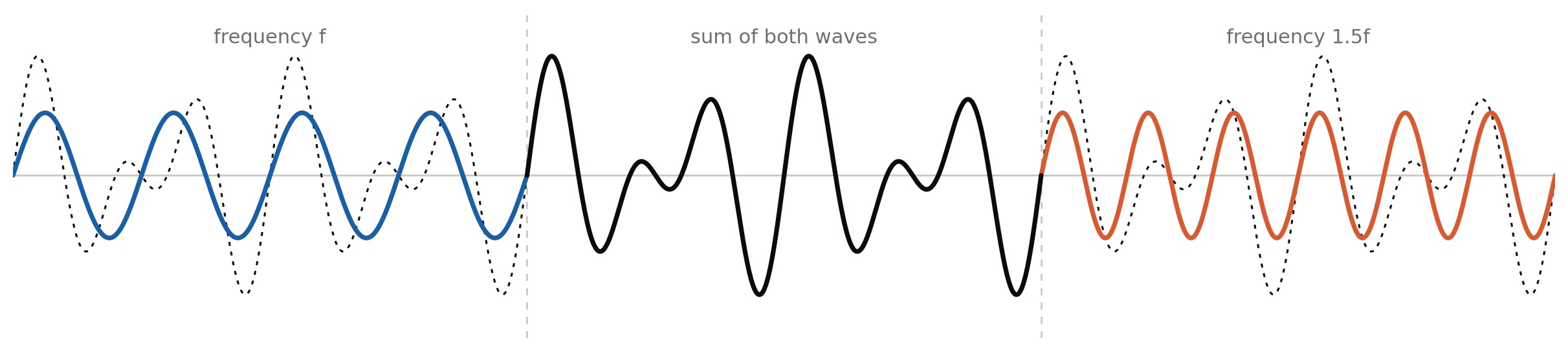
The blue wave has traveled 2/3 of the way across from the left. The coral wave has traveled 2/3 of the way across from the right. The black wave shows the complicated wave when the two mix together in the middle. The dotted line shows what happens when the two mix together if allowed to travel all of the way across.
Here are two waves of the same frequency and in phase.
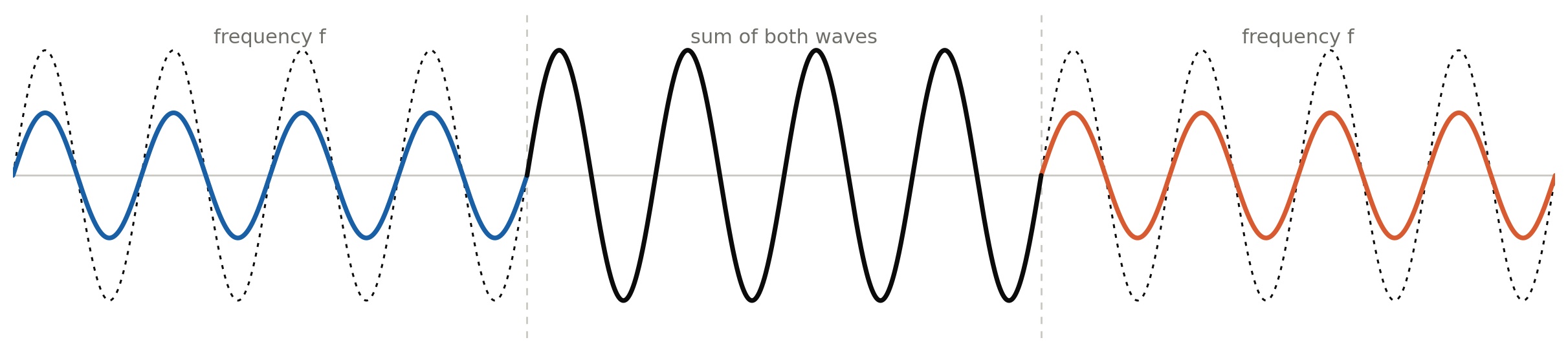
Notice that the wave is bigger where they mix.
Now, two waves of the same frequency but opposite in phase.
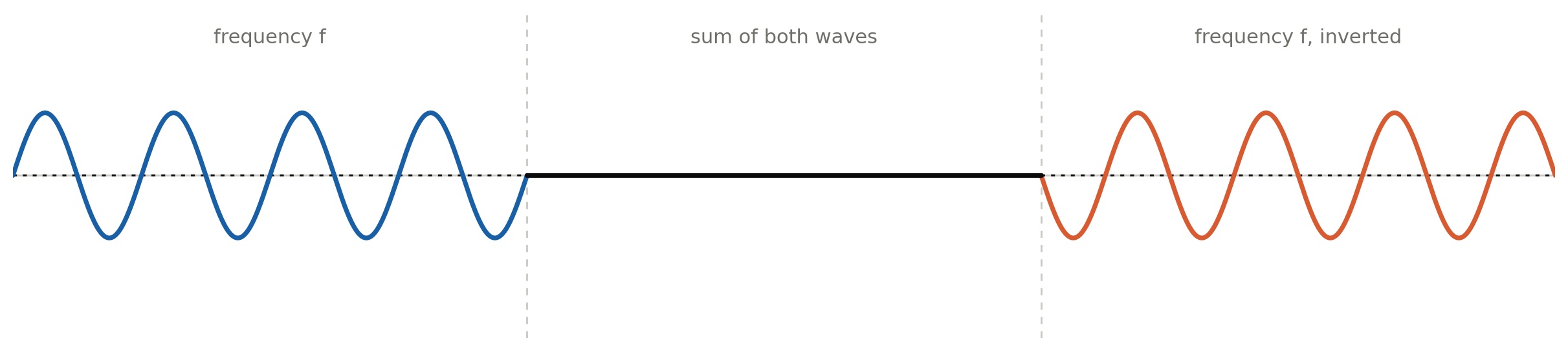
The two waves still exist but appear to be gone where they mix.
Now try to wrap your head around this:
The timeline that you are in right now is a very, very complex wave impossible to describe mathematically but it still behaves like the simple examples above. The very complex quantum wave function that describes the timeline that you are in at this moment is real, has been real and shall always be real. The fact that you cannot see the other timelines does not make them unreal, only untestable.
A way to think of multiple timelines is to think about radio waves. These waves travel on the electromagnetic field. Every broadcast station makes waves in this field. There are thousands of stations. Cell phones, Wifi, TV, bluetooth, radar and many more all sending out waves on this one field.
Yet our radios can pick out an individual signal clearly. All of these signals exist but are invisible until tuned for.
We live in, and only experience, one timeline at a time because we are "tuned" to that timeline, in much the same way that your radio tunes for one signal and ignores all other others.
"I think I can safely say that nobody understands quantum mechanics." - Richard Feynman
The world seems solid to humans, but not to the Fen. Waves and fields are very real in our world of the small scale. Imagine how it would feel if your body was made of magnets. You would be constantly resisting the force of other magnetic fields. Life would certainly not feel solid.
You cannot see most electromagnetic light waves, and can certainly cannot see a static magnetic field from a magnet. Heat is an electromagnetic wave yet you can feel heat on your skin but not see it.
You don’t often look directly at a light bulb so most of that light never gets to you eye. The light waves that you see have been reflected off of something. There are waves all over the place!"
Yep, buddy boy. Think about all of the radio signals shooting around you. You have no idea that they are there until your radio tunes to one of them. One field, millions of signals, just from human radio signals.
You humans have only known about the electromagnetic fields for a couple of hundred years and you still don’t know how they work at the quantum level. This is pure human hubris. You humans do not even know of all of the fields that do exist yet. You are wallowing in ignorance and calling it enlightenment.
"Two things are infinite: the universe and human stupidity, and I’m not sure about the universe." - Albert Einstein
This is exactly why you find it so easy to dismiss the Many-Worlds interpretation. It deals with infinities and humans simply are not equipped to deal with infinities.
But let’s continue with the rest of the quantum quandary solution:
The second problem solved is the randomness issue. Albert Einstein famously stated that ‘God does not play dice with the universe.’
Everett’s solution is eloquent. The randomness would go away if we could see all timelines at once.
In college, when you and your buddies got together drinking beer and smoking weed you did a goofy thing with your color TV. You taped a shirt cardboard over the screen and punched a few holes in it.
What you saw was random flashes of color resulting in exclamations of ‘OOO AHH’. Psychedelic!"
"Yes, Yes, it is hilarious and humbling that we were too buzzed to see the significance of it," Philbert injected.
Passant continued:
"Hilarious too, that it has taken you decades to see the significance of it.
[Interactive: Punch-holes hidden-picture interactive - hidden_picture.js]
Press the ‘punch holes’ button to punch a new hole. Hold the button down to punch holes quickly. The image will become visible.
With just a few holes punched there was no way to tell what the underlying image was. Boys will be boys, so you punched more holes and it got even more psychedelic. There came a point where so many holes were punched that the underlying image could be seen. Boring!
You humans do not have a way to ‘punch holes’ to other timelines so you have no chance of seeing the underlying reality.
The third problem solved by Many-Worlds requires faith, justifiable faith, not blind faith. Justifiable faith is faith supported by internal consistency and absence of contradiction, even without direct proof. Blind faith requires ignoring evidence.
Science requires determinism. To understand how reality works we must have Permanence, Causality and Locality.
Humans have blind faith that some kind of God diddles around with reality. If we pray for rain or protection, God may mess with reality to grant our wishes. So, is it God or is it an alien overlord fiddling around with reality? Seems silly to us Fen but is common thinking for humans.
The Question then becomes ‘how can we have free-will in a deterministic reality?’ Determinism turns all of reality into a clockwork, no free-will.
Humans must evolve on your own, so we Fen will not answer The Question for you. But we can give you hints based on what your science already knows. These should be taken as justifiable beliefs:
- There are an infinite number of timelines.
- Each timeline is fixed from the beginning of time and extending forever.
- There are an infinite number of branches in the timelines.
- Everything that can exist, does exist in one timeline or another.
- Life has free-will. Life can choose a timeline at will. We will talk more about this later.
- Since the minimum time increment is the Planck Time constant, each timeline may be offset in time from the others.
If humans survive the Age of Hubris they will have found that these beliefs are more than merely justifiable beliefs," Passant finished with the added sound effect of jet engine throttling up.
"Whew, that was one heck of an exhortation. I need a break to assimilate and percolate. A beer or two sounds heavenly as well," Philbert said.
Philbert had often thought that ringing in the ears was overflow of too many thoughts banging around in his head. When he flopped down for a nap his ears were ringing like Big Ben and an Indian wedding.
Many nights at Da Baa were observer nights for Philbert. The distraction of listening to others was comforting to him. This was one of those nights. He was always surprised and entertained at how one individual could be a genius and a moron at the same time. Timmay was a perfect example of this.
Timmay lined up his shot with the confidence of a man who had just explained to everyone within earshot exactly why he had missed the last three. The rails were cold, he said. The humidity was up. He believed it.
Philbert watched the object ball miss the pocket by two inches. The cue ball hit the object ball in the wrong place, temperature and humidity had nothing to do with it. The humidity was real, he’d give Timmay that, but the cue ball Timmay was shooting with hadn’t been wiped down since the Clinton administration and the tip on his cue looked like something that had lost a fight with a paving stone. Those two things together could account for every missed shot Timmay had made since Philbert arrived.
He thought of something Passant had said to him that morning. Beliefs are comfortable, Philbert, because they don’t require you to look at anything too closely. A belief about the temperature requires nothing of you, no change, no effort, no admission of fault. Knowledge is uncomfortable because it tends to point directly at the thing you’d rather not examine. It hurts to find out that you are wrong.
Timmay believed in cold rails the way some people believed in horoscopes, not because the evidence supported it, but because the alternative was to admit that the problem was the man holding the cue.
Jed was in the Da Baa often. Jed knew everything that there is to know about pool equipment, it had been his life since he was a young man. Jed could fix Timmay’s cue tip. Philbert himself had advised Timmay about how little the rail rubber changes with temperature. But Timmay stuck with his beliefs and his game suffered for it. No one person can be expert at everything. Many experts, with humility and cooperation, fit together like puzzle pieces. Unfounded beliefs don’t mean shit.
The next day the discussion continued in an unexpected way.
"You were frustrated with Timmay last night, why?" Passant asked.
"It’s that Timmay has the natural skills that I don’t have. He has a beautiful stroke, he sees the table well and his strategy is good but his game suffers because of the bone-headed beliefs he has. Yes, it’s frustrating," Philbert replied tersely.
"It’s the way of the world in The Age of Hubris, dear boy. I suspect that this is why it’s so frustrating to you. By extension, it is the exact reason that humans are on the brink of extinction.
Still though, you believe that mutual assured destruction will prevent nuclear holocaust. You believe that your immediate comfort and convenience trumps the long-term survival of the species. The very experts that should be listened to are called "elitists" and ‘book smart without common sense’," Passant said.
"Damn, you are a buzz kill," Philbert exclaimed.
"Yes I am, but there is hope."
Philbert’s discouragement is understandable, but he will soon be reminded that humans are incredibly adaptable. Massive changes in human culture have occurred many times in history. Humans dropped idol worship for monotheism in just several generations. The Magna Carta changed how cultures view human rights. The Enlightenment put science above blind faith. The abolition of slavery, the shift from divine-right monarchy to democracy, the global acceptance of germ theory. These are all cultural changes.
All is not lost.