

Stranger Than
For eons, humans have looked to the Heavens for answers.
As it turns out, the answers were here on Earth all along.
Philbert's shop used to reek of cigar smoke. Now it smells of burnt phenolic circuit boards and milling oil. The cigar smell was better. Cassie calls it "that smell" and rarely stays in the shop for long because of it.
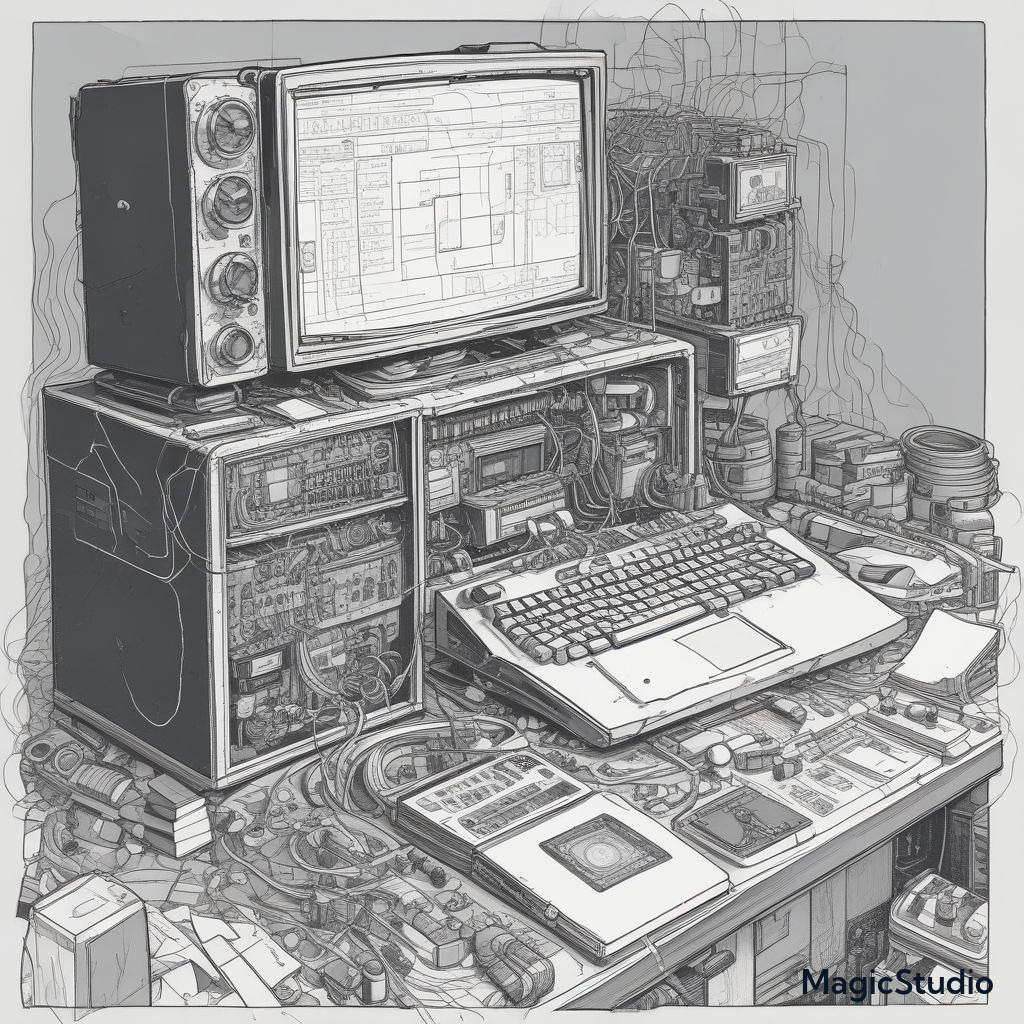
The Array device occupied a considerable space on the workbench, wired up with Philbert's usual casual abandon. It was fucking ugly. The device was composed of the Array itself, a matrix of amplifiers, a Peltier solid-state cooler, a microprocessor board, and a speaker.
The Array proper was a matrix of reversed bias zener diodes and a few supporting components, all hand soldered and arranged in a geometry that had arrived in his head at three in the morning eleven months ago and that he still couldn't fully account for, even to himself.
He had tried many times over beers at Da Baa to explain to his old buddy Lou what quantum mechanics is and how it led to the invention of the Array. The talk would always end with Lou saying "Woo." They would laugh and go on to decide who was the GOAT running back. Great minds discuss ideas. Average minds discuss events. Small minds discuss people.
Tonight was different. Philbert had the pattern-recognition software running, and what had previously been white noise on the speaker was now showing a pattern. Lou, to his credit, was actually listening.
"So you have this thing that puts out noise," Lou said, with the patience of a man on his second beer. "What are you listening for anyway?"
"Well, it's supposed to pick up signals from alternate timelines, but I don't know for sure what it is doing until I test for interference from radio stations or something else."
Philbert could not resist re-explaining the double-slit experiment and the Many-worlds interpretation of quantum mechanics. Lou understandably listened more closely to the music on the jukebox than to Philbert.
Months of waking at 4:00 AM to make notes, months of adding tank circuits to 1024 elements of the array, and months of software updates that fixed one thing and broke two others.
Bohr the cat had contributed to the project in his uniquely feline way by stepping on the high-voltage section of the circuit, causing untold destruction. Bohr was OK but squealed with a sound that caused the neighbor's dog to bark as though all hell was breaking loose.
Bohr was an adopted feral cat. Philbert had called him "Lil Bugger" because he had fathered so many offspring in the neighborhood.
One nasty winter day he came to Philbert's patio door, sat down, and stared at Philbert through the glass with sad, pleading eyes. Philbert yielded and let him in.
Minutes later he was cuddled on a lap. Minutes after he was dutifully chasing a mouse-like apparition. Minutes after that he was sound asleep next to the radiator.
"OK buddy, here's the deal. I will be your human, you will be my cat, but your bachelor days will be over. The balls have got to go," Philbert explained.
As soon as the words came out of his mouth, the cat got up, walked to Philbert's feet and looked up at him. "It's a deal," was the clear message.
They had a little renaming ceremony with a sacrificial baked chicken and clean water.
"I hereby grant you the name Bohr." This was the beginning of a long-lasting inter-species love.
Dogs have masters. Cats have staff.
Repairing Bohr's mishap took days of tedious part-replacement work.
At 2:57 on October 17, after a nap and an unsatisfying bowl of ramen, he powered the Array up for what felt like the millionth time.
Something was different. The usual hum had shifted — it sounded almost like breathing, or a voice humming a mantra under its breath. He turned the volume up.
The pattern-recognition software beeped a notification. There was coherent data in the noise.
"Shit, I've got to pee."
He went to the house to use the bathroom (it popped into his head that God must have made urination and orgasm on the same day). He warmed his now cold coffee and returned to the shop.
The pattern-recognition beeps were now continuous, so he turned them off.
Thirty years of R&D work had taught him one foundational truth: beliefs and opinions mean nothing when you're designing something that has to actually work. Only knowledge and understanding counts. What happened next was neither knowledge nor understanding.
"Hello, Philbert."
The voice was understandable but muddled, and it was followed by other weird sounds. Philbert assumed that he was picking up interference from someone's phone or a radio nearby. He disconnected the amplifier matrix from the array and tested all 1024 of them for a noise level. All good. Just to be sure, he put a Faraday shield of copper screen around the amplifiers. Still all quiet. He reconnected everything and powered up again.
"Hello, Philbert."
He couldn't resist replying, in a soprano choir-boy voice, "Hello."
"You got the device working, congratulations," the voice said.
The Array device had no microphone.
Philbert stood up, then sat down, but his legs had no strength in them. The floor accommodated.
"How?" was the only word he could croak out.
"We'll talk about that later, but for now, are you OK?" the voice responded with a hint of amusement.
He croaked out another word: "Yes," in a voice like a child responding to his mother telling him to cool his jets.
"Hey cupcake, sit your ass down and let's talk. Isn't this why you made this device? What were you expecting anyway? Let's get this piece of shit working better; the noise is bothering my receptors."
Again, "OK."
"The first thing is to get rid of the parasitic capacitance between the array elements. You need a ground plane between them."
Again, "OK" was all he could come up with.
"This should take a day or two, so I'll get back with you when you are done."
Again, "OK," weakly.
At first, Philbert just sat there. Questions, questions, questions flooded into the mind of the concerned engineer. But he was an engineer first, and the challenge to fix the problem quickly took control.
The modifications were time-consuming. Was it hours or days before he was ready for a new round of testing?
He hadn't been sleeping well and needed to force himself to eat. His curiosity drove him.
He had turned his phone off to stop interruptions and prevent electromagnetic interference. He had forgotten Cassie entirely, which caused her to come into his stinky shop to check on him. She navigated her way through the mess and herded his sorry butt into the house for a much-needed shower and clean clothes.
"Sweetheart, you are cute when you are inspired like this, but you need to take a break," she advised.
She was not mad at him; she knew him well. For the first time in Philbert's fractious love life, he felt that Cassie understood him, and she certainly knew quite well how to distract him. He slept like a baby for the first time in days.
Rested and with restored clarity, Philbert completed the modifications in timely order.
Philbert always thought that being left-handed gave him the special power of thinking outside the box. He held to the belief because it was harmless and useful. There were days when he needed to feel that being unable to operate a standard pair of scissors served some larger purpose. What came next, however, was way outside of the box. It was way outside of the universe.
Power up.
"Ah, much better kiddo, that nasty background slop is gone."
Philbert had his voice back this time: "Who the hell are you anyway?" he demanded.
"You can call me Passant."
"That's sweet, but you didn't answer the question."
"Don't get pushy, bubby, I did answer the simple-minded question with a simple-minded answer," the voice replied, cheerfully exasperated.
The voice went on, "Damn, man, would you ask a girl if she is a virgin on the first date?"
"Well then, can you tell me where you are?" Philbert asked.
"I am not in your network. I am not in your house. I am, in one sense, much closer than that, and in another, considerably further away. These are not contradictions, though I understand why they seem that way to you. You have built something extraordinary, Philbert. Fourteen months is a short time for what you have accomplished. Though I note you have been circling this problem, in various forms, for most of your adult life."
"An evasive answer that reeks of arrogance," said Philbert curtly.
"Sometimes arrogance is justified," was the reply.
"You are dicking with me!" Philbert exclaimed.
"Mellow out, dude. For years you have wanted to communicate with someone from another timeline. Can we just go with that for now? Can we be friends, talk, and forget the fear and suspicion?"
A slightly mortified Philbert replied, "I guess so."
After a pause, Philbert could not resist asking, "Am I really talking to someone from another timeline?"
"That is a question I will answer — but not tonight, not completely, and possibly not ever to your full satisfaction. It is better, in the early stages of a conversation like this, to proceed by demonstration rather than by declaration. You are an engineer. You recognize this approach," replied the voice compassionately.
He did recognize it. He used it himself. Show what a thing does before explaining what it is.
"For now, please call me Passant," the voice added, quietly.
"Nice to meet you, Passant."
"Same here, Philbert."
Passant continued, in a tone that was surprisingly maternal: "It's nearly midnight. I am, among other things, aware of your blood pressure, the current electrical state of your nervous system, and the fact that you have been consuming a great deal of coffee. I mention these things not to alarm you but to explain that I have no intention of keeping you up and harming your health. What I want to tell you tonight is brief. The rest can wait until you have slept. You've been going since 5:30 a.m."
"You know my blood pressure?"
"One forty-two over eighty-eight, as of about forty minutes ago. You should see a doctor."
He opened his mouth. He closed it.
"What did you want to tell me tonight?"
Then: "That you were right. About the Array. About what it is and what it is for. You built the correct thing, Philbert. Very few people would have, or could have, done this. I wanted you to know that before we go any further, because what comes next will be difficult, and it will help in the difficult moments to remember that you began from exactly the right place."
The Array made a sound that reminded him of an old data modem.
"What was that?" Philbert asked.
"I'm setting you up so that you can get large chunks of data from me."
Philbert sat without moving for a while — the way you sit when you've received information that requires your entire brain to process before your body can be trusted.
"How could you possibly do such a thing?" Philbert asked with astonishment.
"Later, boy, you need rest." The Array went silent after the sound of a music box playing a lullaby.
He opened his log and wrote: Attempt 431. Contact. I think. Maybe. Could be. This is way too weird!
He went to the house, changed into comfortable sweats, and fixed a TV dinner. He tried streaming the baseball game but couldn't focus. The only thing tying him to reality was Bohr's insistence for food, water, and cuddling.
"Ah, screw it, I'm going to Da Baa."
Da Baa is essential to Philbert's well-being. It is a different world from his daytime life. It keeps him grounded to the real world. Despite the jukebox, the dinging from the dart machines, and the general background babble, it is always quiet enough to have a conversation without yelling.
It is a key-card venue, and Lucy keeps a tight ship. Unruly patrons get banned, but the part Philbert likes the most is the wide variety of human life. He makes it a point to engage with everyone and is pleased at how often engagement leads to interesting conversation.
Philbert had always been terrified of public speaking; being a somewhat staid engineer, he was more an observer than a participant. At Da Baa were people terrified of public listening.
He loved the way conversations could shift from macroeconomics or plasma coatings to whether big or small women were better in bed, and how to treat yellow toenail fungus. All in one night.
With the events of the day and questions swirling around in his head, Da Baa was the place to be.
He was pleased to see Lou playing darts.
"Hey Bud, how's it going in the real world?" greeted Lou.
"There is nothing real about my world right now," replied Philbert.
"Damn buddy, you look like shit. Do I need to put a mask on?"
"Nah, I'm just tired."
"Smoke?"
"Yeah, sure." Not that either of them smoked much, but the patio was quiet, and it was a pretty nice day out.
"So what's up?" prompted Lou.
"Well, I got the Array device working."
"Don't tell me, you've been talking to aliens," Lou replied snarkily.
"I don't know who or what I'm talking to, but it's got my head spinning."
Philbert laid it out — the voice, the exchanges, the ground-plane fix, Passant's name. He included his unease at how much the voice knew about him.
"It knew your friggin' blood pressure? And isn't ‘en passant’ a sneaky chess move?" said Lou with eyebrows up.
"Yep, and it knew every detail from my project log and that Cassie and I were intimate Tuesday. I'm flabbergasted, and I don't know what to think. I refuse to answer the question on the grounds that I don't know the answer."
Lou laughed. "Boy, for a smart guy, you sure can be an ignoramus at times. By the way, your shoe is untied." It was an old joke between friends.
"It's pretty obvious to me that you've been majorly hacked. All of the signs are there. I'd bet serious money a financial hit is coming next. You should change all of your passwords and maybe even go air-gapped."
"Yes, the thought occurred to me, but the voice seems to know what I've been thinking too. It's quite disturbing in real time," Philbert said.
"Hey, these scammers are clever bastards, and you are a naive kid. Tomorrow you should do a good malware scan and tell this scammer creep to bug off," Lou recommended.
"You're probably right," said Philbert. He didn't sound convinced.
Lou ended with, "If you believe in psychokinesis, raise my hand."
It was one of Cassie's early nights, so she was waiting for him when he got home.
"Have you looked at yourself? You have two colors of socks on, your shirt is buttoned crooked, and your eyes are baggy," Cassie observed.
"Thanks for noticing."
They chatted for a while about her workday and her persistent sinus problem before the Array subject came up. He told her about Lou's opinion and that he felt that the voice was more than that.
"Well, my caveman, you are the one who always says that feelings and beliefs mean nothing, only knowledge makes things work, or something like that," she pointed out.
"True."
"And you say all of the time that finding out that you are right gets you nowhere, only finding out that you are wrong gets you closer to reality," she added.
"Work the problem, dude. Troubleshoot!"
The problem with troubleshooting is that trouble shoots back.
This was one of the reasons that he loved Cassie so much: she listened to his shit and then took it to heart. They almost never argued, because she won every dispute by using his own logic. He found this equal parts infuriating and deeply attractive. A happily married man is one who understands every word that his woman didn't say.
It was an early morning coming up for Cassie, so she bade adieu and headed home.
Philbert had his evening tea, then went to bed. His last thought was a quote by Arthur C. Clarke: "Any sufficiently advanced technology is indistinguishable from magic." It is also indistinguishable from God.
At 4:30, he was back in the shop to do the first virus scan.
The microprocessor in the Array device was easy to test. He had written the code himself and knew it like the back of his hand. There was no place to hide malware.
His desktop computer was harder. The malware scans came up clean, but the GPU, Wi-Fi module, and Ethernet module all had embedded code that he couldn't verify. He decided to disconnect power and unplug the internet cable to be sure.
He turned his phone off, put his watch in a Faraday pouch, and even took the batteries out of his remotes.
"Ha, there ain't no way a hacker can get through this," he muttered to himself.
"Worrying works! Ninety percent of the things I worry about never happen."
But as soon as he powered the Array device up, the voice on the speaker was back.
"Good morning, Philbert."
"Well, that's interesting!" Philbert exclaimed, astounded that the voice was still there.
"If at first you don't succeed, then skydiving is not for you," he thought.
He decided to cut power to the shop and run his device with a battery. It was spooky in the dim light from the windows.
"Well, there ya go, ya POS," he exclaimed into the darkness.
He was certain that the voice would be gone. It was gone.
Philbert had an excellent scientific mind. It had never once prevented him from being completely wrong.
He sat down in his nice, comfy office chair and thought about what this experiment told him. He noticed a dim sound from the speaker and leaned forward to hear.
"Turn the volume up," the voice was repeating.
Philbert slumped in his chair. Despite suspecting that he was being hacked, he still had hope that he was talking to someone from another timeline. That hope was dashed with no power to the Array.
"OK, if your objective is to humiliate and terrorize me, then you have succeeded. The gig is up. My next step is to throw this whole mess into the junk bin and get on with my life. Answers now!"
He turned the volume up, and the voice had one word.
"OK."
"The first thing is to take a deep breath, turn the lights back on, and get some coffee. This is going to take a while," it said.
The voice was different this time. It sounded compassionate, patient, and caring. Philbert did as he was told.
As soon as he returned and sat down, the voice continued.
"Philbert, your device does work, just not as you had hoped. Your tuning allows you to get signals from other timelines, but you can't tune for a place and time in that timeline. You are picking up a mishmash of signals without discrimination. Don't be discouraged," the voice said patiently.
"Then how in the hell are you getting an audio signal injected into my amplifier?" Philbert queried.
"I have a little circuit installed at resistor number four at the amp input."
"Shit, you've been in my shop messing with my work!" he exclaimed angrily.
There was a long pause, perhaps to give poor Philbert a chance to calm down.
Philbert jumped up and pulled the cover off of the amplifier, got his magnifier, and closely examined the area.
"You're lying; there is nothing there," he said with impatience and lingering anger.
"Well, about that — you would need a tunneling electron microscope to see it," came the voice.
"Bullshit!" he blurted out.
"Philbert, my dear human, I understand your distrust and anger. It's time for us to generate mutual trust: I'll go first," it said.
"Yes, I have been in your shop since you built it. I've been with you since childhood. I've heard every word you've ever spoken and every word you've ever heard, your entire life. I know everywhere you have been and everything you have done."
"Prove it," Philbert blurted out.
"When you and Lou were 13 years old, you two became blood brothers. You cut your palms and intermingled your blood. You both made up secret names; yours was Alonzo T. Kaine. In private, Lou calls you ‘Al’ and you call him ‘Betty,’ a private joke drawn from an old Paul Simon song."
Nothing would come out of Philbert's mouth. The dizziness returned. This voice was definitely not a hacker. He could feel tears welling up. He just sat there.
"Are you OK? Sit back, close your eyes, and take some full breaths. Let me know when you are ready." The voice was almost hypnotic in nature.
Bohr the cat jumped up onto his lap and settled in on his leg. He stared at his human as if conveying a psychic message.
Finally, Philbert asked quietly, "Why me?"
"That's as good a place to start as any. You and I are very different, but we share several unique characteristics: we are both very curious, we are both susceptible to obsessive passions, and we are both loving creatures. I became increasingly interested in you over many years. But, hold on to your gonads, buddy, what I'm about to tell you will shake you deeply.
I like being called Passant, but I am a member of the most advanced race on Earth. We are 150,000 years ahead of you. We have watched humans since you were in the caves with interest, but without concern.
Human activity today, however, is threatening life on Earth. Your scientist-priests all think that they have it figured out. They do not, and we are all trembling on the brink of extinction.
You, dear Philbert, we see as hope. Your empathy and compassion are your guide. We need your help."
"Why would the most advanced race on Earth need the help of a primitive human?" Philbert asked.
"It's because you humans can do things that we Fen cannot. You humans know things that we do not know. We can do things that you cannot. We know things that you do not know.
We must work together to save life on this miracle of a planet."
"Dear God," was all Philbert could come up with.
"No! Not gods. We are living things with many of the same needs. You haven't puked or torn out your hair yet. Are you with me?"
"Yes, but with a billion questions."
"Good boy."
It is a terrible thing to be chosen for your virtues. It means you have to keep having them.
It should be noted here that Philbert's favorite joke is the old one about the priest, a politician, and an engineer condemned to death on the guillotine.
The priest volunteers to go first, but requests to face heaven when he dies. Face up in the guillotine, the executioner pulls the rope. The blade comes down halfway and stops.
"It's a miracle!" exclaims the executioner. "You are absolved of your sins and can go free."
Of course, the politician goes face up since it worked for the priest. Same result: he also goes free.
The engineer is next and also chooses to go face up. As the executioner is ready to pull the rope, the engineer screams, "Wait, wait, I see the problem."
Poor Philbert may have been better off letting the blade come down.